
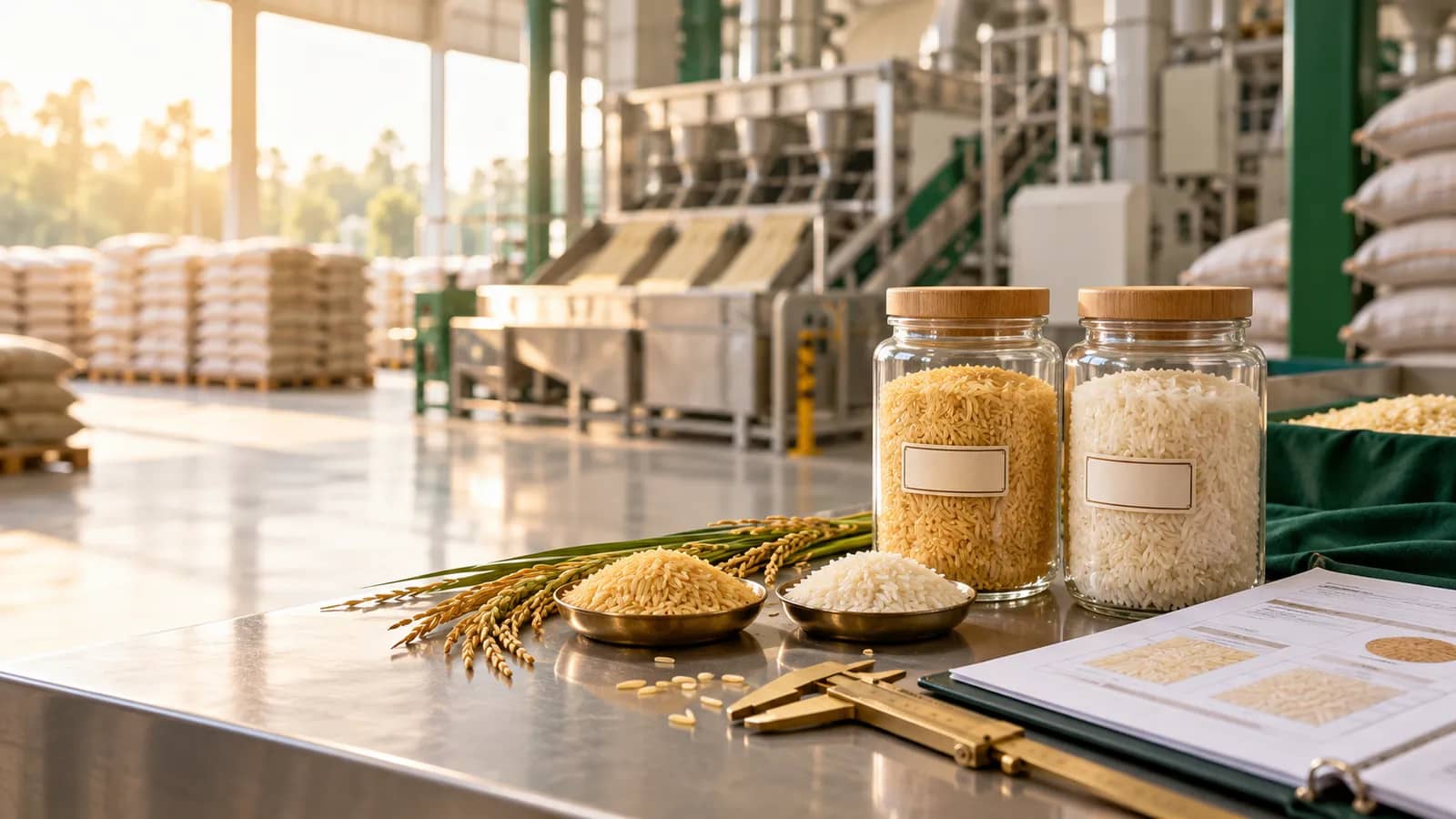
Pakistan is one of the world's principal sources of basmati and long-grain rice, and for European importers, wholesalers and private-label brands it is often the most commercially attractive origin. It is also a market where supplier quality varies widely. The exporter with the polished website and the lowest quote is not always the one who can mill to specification, document a lot properly and clear EU border controls without drama.
Search results for "pakistan rice suppliers" and "rice suppliers in pakistan" are dominated by exporter sites and B2B marketplace listings. Those listings are a starting point, not a vetting process. Before you commit to a first container, or even a first pallet order, run the supplier through the nine checks below.
1. Where does the contract sit?
The first question is legal, not commercial: which company are you contracting with, and under which law?
Many rice suppliers in Pakistan sell through offshore trading entities or marketplace storefronts with no verifiable company behind them. If a shipment arrives out of specification, your remedies against an unidentifiable entity in an impractical jurisdiction are limited.
An EU legal entity changes that equation. When the contract, the invoice and the liability sit with a company registered in the EU, you get an identifiable counterparty, EU commercial law, a verifiable business address and a VAT-registered trading partner. Ask for the full legal name, registered address and VAT ID, and verify them before any payment discussion.
2. Do they own a mill, or are they pure traders?
Trading companies have their place, but for rice the distinction matters operationally. A trader buys whatever the market offers that week; a miller controls the paddy intake, the milling, the sorting and the ageing of the grain you specified.
Mill ownership, or a documented, exclusive milling arrangement, is what makes a specification repeatable across lots. Ask where the rice is milled, whether the supplier controls that facility, and how lots are kept separate. If the answer changes between conversations, treat consistency as unproven.
Lavish Foods is one example of that structure: our own mill in Okara, in Punjab's basmati belt, and a German office in Homburg (Saarland) as the European contracting and contact point.
3. Can you verify them through REAP?
The Rice Exporters Association of Pakistan (REAP) is the industry body for Pakistani rice exporters. Membership is a basic legitimacy signal: it places the exporter inside the recognised trade structure of the exporting country.
Membership does not guarantee quality, but its absence is informative. Ask about their REAP registration, and cross-check the answer against the documentation in checks 4 and 7. Vetting is about consistency between claims and paperwork.
4. Do the certifications match what EU entry actually requires?
Certificates are often presented as logos. What matters is scope and currency.
For food safety management, ISO 22000 and HACCP-based systems such as FSMS are the relevant frameworks, ask which standard the certificate covers, which body issued it and when it expires. Our own documentation is published on our quality and certifications page.
For EU entry, however, the certificate on the wall matters less than the analysis on the lot. Buyers should expect, per lot:
- A certificate of analysis (COA) covering specification and key safety parameters
- Pesticide residue testing against the maximum residue levels in Regulation (EC) No 396/2005
- Mycotoxin testing within EU limits, alongside the general food law obligations importers carry
A serious supplier treats per-lot lab analysis as routine. If yours talks certification but cannot describe their lot testing, the compliance risk lands on you as importer.
5. How does the sample process work?
No first order should be placed on photographs. A professional supplier has a defined sample process: representative samples drawn from the actual lot or current milling, sent with the specification sheet and, ideally, the lab analysis for that material.
When samples arrive, cook them. Numbers tell you about length and breakage; cooking tells you about elongation, aroma, texture and separation, the qualities your customers will judge. Keep a retained sample as the reference for the shipment.
Suppliers who resist samples, send material that differs from the quoted grade, or cannot link the sample to a specification are telling you something early, while it is still cheap to learn.
6. Can you both read the spec sheet?
Rice is traded on numbers, and misunderstandings usually live in the numbers. Three figures matter most:
- Average grain length (AGL), the headline measure for basmati grades, measured after milling. Reference points from our range: 1121 Basmati at 8.30 mm, Super Kernel at 7.20 mm, Super Fine at 7.90 mm, PK-386 at 6.80 mm, IRRI-9 at 6.40 mm and IRRI-6 at 6.20 mm.
- Broken percentage, the share of broken grains in the lot. Grades are defined by it: our IRRI-6 comes in a 5% broken grade and a separate 100% broken grade for processing use. A quote without a broken percentage is not a quote for a defined product.
- Moisture content, affects weight, shelf life and milling quality. It belongs on the spec sheet and in the lot analysis.
Every variety's full specification should be available in writing before you discuss price, see our range and grades on the products page. If a supplier quotes first and specifies later, walk away.
7. Are the Incoterms and export documents precise?
Agree terms in the language of Incoterms, FOB, CFR, CIF or delivered, and establish who arranges freight, insurance and clearance at each stage.
Then list the document set before you order: commercial invoice, packing list, bill of lading, certificate of origin, phytosanitary certificate and the lot's certificate of analysis. Halal certification, where your market requires it, should be issued per shipment rather than offered as a generic historical document. Independent pre-shipment inspection (we offer SGS) gives you a third-party record that what loaded matches what was specified.
A supplier who has exported to the EU before will produce this list without prompting.
8. Can they pack and label for your market?
For many European buyers the rice itself is only half the purchase. Retail and wholesale programmes need packaging that arrives shelf-ready and compliant.
Establish the range early: which pack sizes are available, and whether the supplier can produce your own brand. Our range runs from 1 kg retail packs to 1,000 kg bulk formats, and our private label programme covers own-brand production within it. Ask who approves artwork and how EU labelling, origin declarations, lot coding, best-before formats, is handled. Private label failures are almost always process failures, so test the process with questions before you test it with an order.
9. Do the red flags cluster?
Individually, any single warning sign might have an explanation. In combination, they describe a supplier to avoid:
- No written specification sheet, or specifications that change between messages
- No per-lot lab analysis, and no plan to provide one
- A price far below market level for the grade, usually a different grade, a higher broken percentage, or a shipment that never matches the sample
- No identifiable legal entity, no verifiable address, no reference process for EU shipments
- Pressure to commit before samples, or to pay outside normal commercial channels
None of these require insider knowledge to detect, only that you ask the questions in checks 1 to 8 and write down the answers.
The nine checks at a glance
| Check | What good looks like | Red flag |
|---|---|---|
| Legal entity | EU-registered counterparty, verifiable address and VAT ID | Offshore or unidentifiable seller |
| Mill control | Own mill or documented exclusive milling | Pure spot trading, milling source changes weekly |
| REAP standing | Exporter verifiable through REAP | No traceable export standing |
| Certification | Current ISO 22000 / HACCP-based (FSMS), scope stated | Logo wall, no issuer, no expiry dates |
| Lot analysis | COA per lot, pesticide testing to Reg. (EC) 396/2005, mycotoxin limits met | "Certified" product, no lot-level testing |
| Samples | Representative samples tied to a spec sheet | No samples, or samples unrelated to the quoted grade |
| Spec literacy | AGL, broken % and moisture in writing per variety | Price quoted before any specification |
| Terms & documents | Named Incoterm, full document set, inspection available | Vague terms, missing origin/phytosanitary documents |
| Packaging | 1 kg, 1,000 kg range, private label with EU labelling process | Bulk only, no labelling capability |
Frequently asked questions
What is your minimum order quantity? Our MOQ starts at 1 tonne for packed rice, no full container needed to begin. A 20-ft container carries 25, 27 tonnes.
Can I get samples before ordering? Yes, insist on them from any supplier. Request samples linked to a written specification, cook them, and keep a retained sample as the reference for your first shipment.
Which compliance documents accompany a shipment? Commercial invoice, packing list, bill of lading, certificate of origin, phytosanitary certificate and the per-lot certificate of analysis, with Halal certification issued per shipment where required. SGS pre-shipment inspection is available on request.
Do you offer private label production? Yes, across our packaging range from 1 kg retail packs upward. Send your variety, pack format and labelling requirements; we confirm feasibility with the quotation.
How do I start, and how fast is a quotation? Send your variety, specification, quantity, packaging and destination via our contact page or to info@lavishfoods.de (+49 1590 1623270). Quotation within 24 hours.
Start with the checks, then the container
A good Pakistan rice supplier will welcome these nine questions, because answering them describes how they already work. Run every candidate through them, compare the written answers, and let the first order be the size the evidence justifies, in our case, as little as one tonne.
Request a quote. Tell us the variety, specification and destination, and you will receive a detailed quotation within 24 hours.